
Ryan Walker, CFP®
Many people approaching retirement eventually ask: “Have I saved enough?” You may have heard ideas like $1 million is enough, or that you need 10x your annual salary, 25x your annual expenses, or that following the 4% withdrawal rule should be enough to retire.
While these are helpful starting points, the real answer is much more personal than that. No single rule of thumb can determine whether you're financially prepared for retirement. Rather, a combination of factors should be considered, including your retirement age, spending goals, Social Security and pension income, taxes, healthcare costs, longevity, legacy planning, and other personal circumstances.
Understanding how these factors work together can help you establish a more meaningful retirement savings goal.
Start With How Much You Expect to Spend in Retirement
One of the first steps in determining how much you need to retire is evaluating your anticipated expenses and the lifestyle you want to maintain. Begin by considering your day-to-day expenses such as housing, food, utilities, transportation, healthcare premiums and out-of-pocket costs, insurance premiums, and vehicle and home maintenance. In addition to the expenses you currently have while working, you may also want to account for goals like increased travel, pursuing new hobbies, family assistance, entertainment, or spending part of the year in another location.
It's also important to recognize that retirement spending will change over time. Inflation can increase costs, your goals may change, or health circumstances can significantly affect your financial needs in retirement. For instance, two households with identical salaries and investment balances can need two very different amounts to retire comfortably because their spending goals are likely different. This can help shift your thinking from “How much do I need to retire?” to “What expenses will my retirement savings need to cover?”
Retirement Rules of Thumb Can Give You a Starting Point
As you are researching how to retire comfortably or how much you need to retire, you will likely come across many rules of thumb.
These common retirement savings benchmarks can help you develop an initial estimate, but each relies on assumptions that may not reflect your individual circumstances.
What Is the 4% Rule?
The 4% withdrawal rule is based on someone who has a 30-year time horizon after retirement. The rule suggests that a retiree can withdraw 4% of their initial portfolio balance in the first year of retirement, then adjust that dollar amount annually for inflation, with the goal of making their portfolio last throughout retirement. However, the rule may fall short for those who have a longer than 30-year time horizon after retirement, or those who wish to leave behind investments for their heirs. For those with a longer than 30-year time horizon, Morningstar estimates lower starting withdrawal rates: 3.5% for a 35-year retirement horizon, 3.3% for 40 years, 3.1% for 45 years, and 2.9% for 50 years.
What Is the 25x Rule?
The 25x rule assumes that saving up 25 times your annual expenses in your investments will produce a positive retirement outcome. One key consideration for this rule is to only consider the amount of money you will need from investments. Something to remember is that a portion of your anticipated spending needs may be met by other income sources. For example, someone who expects Social Security or pension income does not necessarily need investments to replace their entire annual spending amount.
For instance, if you expect to spend $80,000 annually in retirement and receive $30,000 from Social Security and pension income, your investments would need to provide the remaining $50,000. Using the 25x rule, that would suggest a retirement savings target of approximately $1.25 million ($50,000 × 25).
This is a simplified estimate and assumes those other income sources are available during the period being evaluated. The 25x rule is also closely related to the 4% rule, since $50,000 represents 4% of a $1.25 million portfolio.
WHAT IS THE 80% RETIREMENT RULE?
The 80% retirement rule implies that you will need 80% of your pre-retirement gross income to maintain your current lifestyle after retirement. Retirement income needs may be higher or lower than 80% of your working gross income. For example, payroll taxes and retirement contributions may decrease or disappear, but oftentimes they are replaced with travel and healthcare costs.
For someone earning $100,000 annually before retirement, this rule would suggest approximately $80,000 in annual retirement income. However, your actual needs will depend on your expenses and retirement goals.
As stated, rules of thumb are great starting points, but market performance, investment allocation, retirement length, inflation, spending changes, and legacy goals for your specific financial plan should take precedence in determining if you are ready to retire.
How Does Your Retirement Age Change How Much You Need to Retire?
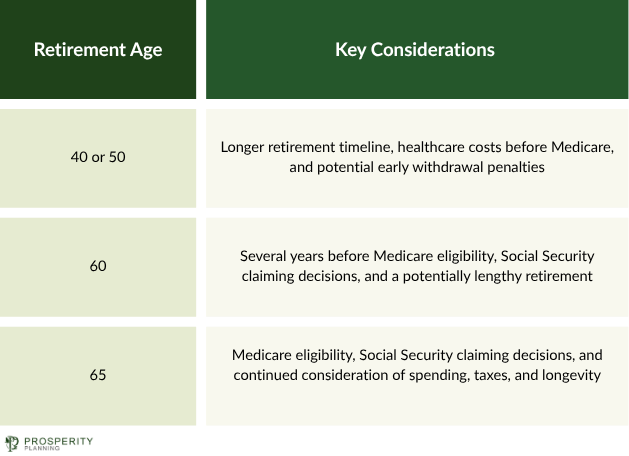
Retiring earlier generally means your savings will need to cover more years of expenses, including any gap before you begin receiving Social Security benefits. If you retire before becoming eligible for Medicare, you may also need to budget for health insurance during that time.
Retiring later can give you additional years to save and potentially reduce how long you’ll need to rely on those savings. Together, these factors can influence how much you need to retire comfortably.
How Much Do I Need to Retire at 40 or 50?
Retiring at or between 40 and 50 presents an unusually long potential retirement time horizon. One of the largest considerations for retirees of this age is healthcare. With Medicare eligibility generally beginning at 65, this scenario presents 15 to 25 years of potential health insurance costs before Medicare. Additionally, depending on your investment account types and circumstances, you may have to pay a penalty to access certain retirement funds before age 59½, although exceptions may apply.
How Much Do I Need to Retire at 60?
Retirement at 60 lessens the time before Medicare and Social Security eligibility, which can eventually offset part of the income needed from your portfolio. However, Social Security retirement benefits generally cannot begin until age 62, and Medicare eligibility generally begins at age 65.
Retirement at 60, with an average lifespan, could still leave your portfolio to support several decades of your lifetime.
How Much Do I Need to Retire at 65?
Retirement at 65 removes one of the largest barriers to retirement for most people, access to Medicare. At 65, you are generally eligible for Medicare, which can help cover healthcare expenses, although premiums, deductibles, and other out-of-pocket costs still need to be considered. For higher-income retirees, Medicare premiums may also increase based on income.
You are also eligible for Social Security retirement benefits at this time, although it could make sense to continue delaying benefits based on your specific facts. While Medicare and Social Security are available to you, other considerations like spending, longevity, taxes, and investment withdrawals still matter. Depending on your other income sources, a portion of your Social Security benefits may also be taxable.
Your Retirement Number Is About More Than Your 401(k)
Retirees often use their 401(k) balance as their gauge for retirement readiness. However, your 401(k) is only one part of your retirement picture. You should also consider other assets and income sources, which may include:
- 401(k), 403(b), 457, and TSP accounts
- Traditional and Roth IRAs
- Taxable investment accounts
- Cash
- Social Security
- Pension income
- Other assets or recurring income
One critical consideration is the tax treatment of each asset and how that affects your distribution strategy. Based on all of your facts, it may make sense to withdraw a portion from pre-tax assets like IRAs, a portion from taxable brokerage accounts, or even Roth IRAs. Each of these accounts can be treated differently on your tax return, and using each one intentionally may help manage your tax liability throughout retirement. Your withdrawal decisions can also affect how much of your Social Security benefits are subject to taxes.
Key Takeaways
|
Understanding Your Retirement Readiness
Knowing how much you need to retire isn’t always as simple as hitting a particular savings goal. Rules of thumb can help you see whether you’re generally on track, but as retirement gets closer, understanding how your savings, income, taxes, spending, and timeline work together becomes increasingly important.
If you’re starting to ask, “Am I really ready to retire?” you don’t have to sort through all of those pieces on your own. Our team at Prosperity Planning, a fee-only fiduciary financial planning firm serving clients in Kansas City and nationwide, can help you take a closer look at where you stand and what your path to retirement could look like. Schedule a no-obligation consultation call with us to get started.
Ready to get Started?
Schedule a call with one of our Certified Financial Planner™ (CFP®) professionals today!

Prosperity Planning is neither an attorney nor an accountant, and no portion of the content should be interpreted as legal, accounting or tax advice. Be sure to consult with a tax professional before implementing any investment strategy. Investment advice, financial planning, and retirement plan services are provided by Prosperity Planning, Inc., an SEC registered investment advisor. The information contained herein, including but not limited to research, market valuations, calculations, estimates and other material obtained from these sources are believed to be reliable. However, Prosperity Planning, Inc. does not warrant its accuracy or completeness. The information contained herein has been prepared solely for informational purposes and is not an offer to buy or sell or a solicitation of an offer to buy or sell any security or to participate in any trading strategy. If an offer of securities is made, it will be under a definitive investment management agreement prepared on behalf of Prosperity which contains material information not contained herein and which supersedes this information in its entirety. Any investment involves significant risk, including a complete loss of capital and conflicts of interest. The applicable definitive investment management agreement and Form ADV Part 2A will contain a more thorough discussion of risk and conflict, which should be carefully reviewed before making any investment decision.


