
Ryan Walker, CFP®
With the 2026 midterm elections approaching, investors may naturally wonder what the results could mean for the stock market. Elections generate strong opinions and plenty of headlines, but history suggests investors should be cautious about allowing political predictions to drive changes to a long-term financial plan. Political uncertainty can make it tempting to act, but your goals and investment strategy should remain the starting point for portfolio decisions.
What History Shows About Midterm Elections and the Stock Market
Looking at S&P 500 returns from 1926 through 2025, research from Dimensional shows that months containing midterm elections have had returns similar to those in other months. That has been true whether Republicans, Democrats, or neither party ultimately controlled both chambers of Congress. In other words, midterm election results have not historically provided a reliable way to predict short-term stock market returns.
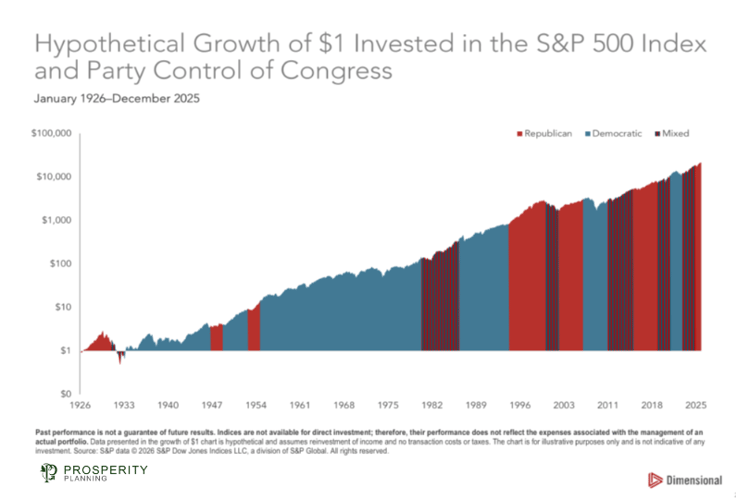
Source: Dimensional.
Past performance is not a guarantee of future results. Indices are not available for direct investment; therefore, their performance does not reflect the expenses associated with the management of an actual portfolio. Data presented in the growth of $1 chart is hypothetical and assumes reinvestment of income and no transaction costs or taxes. The chart is for illustrative purposes only and is not indicative of any investment. Source: S&P data ©2024 S&P Dow Jones Indices LLC, a division of S&P Global. All rights reserved.
The longer-term historical picture reinforces the importance of looking beyond election results. From 1926 through 2025, U.S. stocks trended higher during periods of Republican control, Democratic control, and divided government. Congress can influence economic policy, but markets are also shaped by interest rates, geopolitical developments, technological advances, business growth, and many other factors. Over time, which party controls Congress has not been a reliable predictor of investment success.
Even knowing an election result in advance would not necessarily tell investors how markets will respond. The 2016 presidential election provides a useful example: despite predictions at the time that stocks could decline following a Donald Trump victory, the S&P 500 finished the following day 1.1% higher. Investors would have needed to correctly predict both the unexpected election outcome and the market’s reaction to benefit from acting beforehand. Getting the winner right but the market’s response wrong could have meant selling to avoid a decline, only to miss out on a gain.
So, should you change your investments because of the midterm election? For long-term investors, we believe history makes a strong case for staying disciplined rather than trying to anticipate political outcomes or short-term market reactions. Election seasons may bring uncertainty and volatility, but maintaining a diversified portfolio aligned with your financial plan can help keep the focus where it belongs: on your long-term goals rather than the latest political headline.
A Thoughtful Approach to Election Uncertainty
What does that look like in practice? Staying committed to your plan includes reviewing your investments and making adjustments when they support your goals. The following principles can help guide those decisions.
Stay disciplined—not inactive
We do not believe the data supports changing investments solely in anticipation of an election. That does not mean doing nothing.
An agreed-upon investment strategy, monitored regularly by your team, provides a framework for making displaced decisions in response to market movements.
During periods of market uncertainty, that may mean checking that your mix of investments still fits your goals, when you expect to need the money, and how comfortable you are with market ups and downs. Changes in your life, such as an approaching retirement or a new expense, may warrant adjustments. Election predictions alone, however, are not a reason to change direction.
Rebalance when opportunities arise
One way to stay active within your investment strategy is through portfolio rebalancing. As markets rise and fall, the mix of stocks and bonds you own can move away from your original targets. Rebalancing brings that mix back in line with your plan.
For example, consider a $1 million portfolio with a target allocation of 80% stocks and 20% bonds. Hypothetically, if stocks fell 10% after an election and the other investments remain unchanged, the stock allocation would fall to approximately 78.3%. Rebalancing could involve buying stocks at lower prices to restore the 80% target allocation. Whether to rebalance would depend on your investment guidelines and any taxes or costs involved. The decision would be guided by your plan, rather than a prediction about the election.
Keeping Your Long-Term Goals in View
Election seasons can bring plenty of questions, but you do not need to predict the outcome to make thoughtful investment decisions. Staying disciplined, reviewing your portfolio, and making adjustments when appropriate can help keep your attention on the goals you are working toward.
At Prosperity Planning, we understand that staying focused on those goals can be challenging when political headlines compete for your attention. Our team is here to talk through your questions and help you make investment decisions grounded in your financial plan.
Ready to get Started?
Schedule a call with one of our Certified Financial Planner™ (CFP®) professionals today!

Prosperity Planning is neither an attorney nor an accountant, and no portion of the content should be interpreted as legal, accounting or tax advice. Be sure to consult with a tax professional before implementing any investment strategy. Investment advice, financial planning, and retirement plan services are provided by Prosperity Planning, Inc., an SEC registered investment advisor. The information contained herein, including but not limited to research, market valuations, calculations, estimates and other material obtained from these sources are believed to be reliable. However, Prosperity Planning, Inc. does not warrant its accuracy or completeness. The information contained herein has been prepared solely for informational purposes and is not an offer to buy or sell or a solicitation of an offer to buy or sell any security or to participate in any trading strategy. If an offer of securities is made, it will be under a definitive investment management agreement prepared on behalf of Prosperity which contains material information not contained herein and which supersedes this information in its entirety. Any investment involves significant risk, including a complete loss of capital and conflicts of interest. The applicable definitive investment management agreement and Form ADV Part 2A will contain a more thorough discussion of risk and conflict, which should be carefully reviewed before making any investment decision.


