
Dan Reiter, CFP®, CPA
You may already know where you want your charitable dollars to go. But have you thought about how? Writing a check is simple, but it isn't always the most tax-efficient way to support the organizations you care about. Depending on your age, investments, retirement accounts and tax situation, strategies such as qualified charitable distributions, gifts of appreciated stock and donor-advised funds may allow you to give more strategically.
Here are three charitable giving strategies worth considering as part of your retirement and tax-planning strategy.
1. Give Directly From Your IRA with a Qualified Charitable Distribution (QCD)
If you're age 70½ or older and regularly give to charity, a qualified charitable distribution (QCD) may be one of the first strategies worth reviewing.
A QCD allows eligible IRA owners to send money directly from an IRA to a qualifying charity. When the requirements are met, the distribution can be excluded from federal taxable income. And once you're subject to required minimum distributions, a QCD can also count toward satisfying some or all of your Required Minimum Distribution.
QCDs empower you to donate up to $111,000 (in 2026) directly from your IRA to a qualified charity each year. The beauty lies in how these contributions are treated for tax purposes. The donated amount is excluded from your taxable income, potentially lowering your overall tax bill. This is particularly advantageous if you don't rely heavily on your IRA income to meet your living expenses.
What difference could a QCD make if you’re already giving to charity each year? Let’s illustrate with a quick example:
Suppose Bob and Sue, a retired couple, gives $15,000 to their church every year and one spouse is eligible to make a QCD. Instead of withdrawing $15,000 from an IRA, recognizing the taxable income and then writing a check, the eligible spouse could direct the IRA custodian to send the contribution directly to the church.
The church still receives the same $15,000, but the tax treatment may be very different.
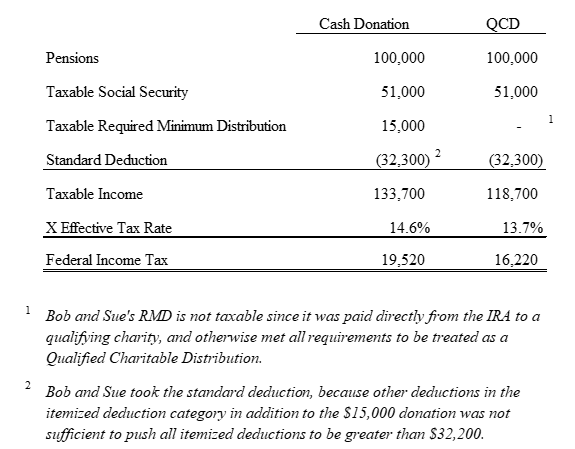
In this example, Bob and Sue gave the same amount to charity in both scenarios. By making their gift directly from their IRA through a QCD, they saved more than $3,000 in taxes compared with giving cash.
Where your gift comes from can make a meaningful difference in how it affects your taxes. If you’re considering a QCD for your next gift, here are a few rules to keep in mind.
- You must be at least age 70½ when the distribution occurs.
- The payment generally needs to go directly from the IRA custodian to an eligible charity.
- QCDs cannot be made to donor-advised funds.
- You don't also claim the excluded QCD amount as a charitable deduction.
If you’re eligible for a QCD, it’s worth asking whether a gift you already plan to make could come directly from your IRA.
2. Make the Most of Your Gift by Donating Appreciated Stock
If you own investments that have increased significantly in value, it’s worth considering whether to donate the shares directly. When you sell appreciated stock, you may owe capital gains tax on the increase in value. Giving the shares directly to charity generally lets you avoid realizing that gain. If you itemize and meet the applicable requirements, you may also be able to deduct the stock’s fair market value.
For instance, imagine you bought stock for $5,000 and it’s now worth $15,000. If you sell it, you’ll realize a $10,000 capital gain. At a 15% capital gains tax rate, that would mean $1,500 in taxes. If you set aside that amount from the sale proceeds, you’d have $13,500 left to give.
If you donate the shares directly, the charity receives stock worth $15,000. If you qualify for a deduction for the full fair market value, you could also claim a $15,000 charitable deduction. That’s where the two benefits come together. More of the stock’s value can go to the charity, and you may be able to lower your own tax bill.
Before donating shares, ask two questions:
-
How long have you held the stock?
-
Can your charity accept it directly?
A deduction for the stock’s full fair market value generally requires that you’ve held it for more than one year. If your charity isn’t equipped to accept shares, a donor-advised fund (DAF) may be another way to support it.
A DAF can accept appreciated shares, and you may qualify for a charitable deduction in the year you contribute them. The fund can generally sell the shares without generating capital gains tax for you, and you can recommend grants to the charities you want to support. Donor-advised funds are available through many community foundations and national sponsors, including Fidelity Charitable.
A donor-advised fund can also make the next strategy, known as bunching, easier to put into practice.
3. Bunching Charitable Contributions Into One Tax Year
Are you a consistent donor to your favorite charities but don’t typically itemize your deductions? Like Bob and Sue in our first example, your charitable contributions and other itemized deductions may not add up to more than the standard deduction in a typical year. Timing may matter almost as much as the amount you give, and that’s where a strategy called “bunching” comes in.
Bunching involves grouping several years’ worth of charitable contributions into a single tax year. If those gifts bring your total itemized deductions above the standard deduction, itemizing that year may lower your taxable income and result in significant tax savings.
A tax rule that took effect in 2026 gives you another reason to think about when you make charitable gifts. If you itemize, you can generally deduct only the portion of your qualifying gifts that exceeds 0.5% of your adjusted gross income (AGI) for the year. Bunching several years’ worth of gifts into one year can help more of your giving count toward the deduction.
While bunching can be a powerful tool, it’s worth discussing with your financial advisor how it fits into your overall financial goals and tax situation. If you expect your taxable income to change in retirement, that’s one factor to weigh alongside your cash needs and future giving plans as you decide when to give.
Which Charitable Giving Strategy Might Fit You?
The best place to start is with how you already give and what you have available to give. Here are a few common situations and a strategy you might explore for each.
|
If you... |
Strategy to explore |
|
Are 70½+ and own an IRA |
QCD |
|
Own highly appreciated investments |
Gift appreciated securities |
|
Give consistently but don't regularly itemize |
Bunching / DAF |
|
Want to donate stock but your charity can't accept it |
DAF |
|
Are approaching retirement and expect your taxable income to change |
Coordinate giving with multi-year tax planning |
If more than one of these options could work for you, it’s worth taking a closer look at what each would mean for your next gift.
The Best Giving Strategy Starts with the Rest of Your Financial Plan
Charitable planning shouldn't happen in isolation. The right giving strategy can depend on your age, IRA distributions, investment gains, tax bracket, deductions and the timing of other financial decisions.
That's why the question isn't simply, "How much should I give?"
A better question may be, "What's the most effective way to give it?"
At Prosperity Planning, we help clients evaluate charitable giving alongside retirement income, investments and multi-year tax planning so their generosity fits within the rest of their financial life.
If you’re planning a charitable gift, you might take a moment before writing the check to consider where the gift could come from. Our team would be happy to talk through your options, whether you’re considering giving from your IRA, donating appreciated investments or using another source, and help you think through what makes sense for your plan.
If you'd like to discuss charitable giving as part of your overall financial plan, call us at (816) 587-7526 or schedule a no-obligation 30-minute conversation
Ready to Get Started?

Schedule a call with one of our Certified Financial Planner™ (CFP®) professionals today!
Prosperity Planning is neither an attorney nor an accountant, and no portion of the content should be interpreted as legal, accounting or tax advice. Be sure to consult with a tax professional before implementing any investment strategy. Investment advice, financial planning, and retirement plan services are provided by Prosperity Planning, Inc., an SEC registered investment advisor. The information contained herein, including but not limited to research, market valuations, calculations, estimates and other material obtained from these sources are believed to be reliable. However, Prosperity Planning, Inc. does not warrant its accuracy or completeness. The information contained herein has been prepared solely for informational purposes and is not an offer to buy or sell or a solicitation of an offer to buy or sell any security or to participate in any trading strategy. If an offer of securities is made, it will be under a definitive investment management agreement prepared on behalf of Prosperity which contains material information not contained herein and which supersedes this information in its entirety. Any investment involves significant risk, including a complete loss of capital and conflicts of interest. The applicable definitive investment management agreement and Form ADV Part 2A will contain a more thorough discussion of risk and conflict, which should be carefully reviewed before making any investment decision.


