
Ryan Noble, CFP®, CDFA®
Turn on the news or browse an investment website, and you're likely to encounter plenty of headlines raising concerns about the bond market. Rising interest rates, disappointing bond returns, inflation concerns, and Federal Reserve decisions have given investors plenty to think about.
Whether you're planning for retirement or investing for other long-term goals, seeing negative bond returns can be particularly unsettling, especially when bonds are often included in a portfolio to help provide stability.
While headlines tend to focus on recent performance, they don't always tell the full story. Higher interest rates can put pressure on bond prices in the short term while also creating opportunities for greater income over time. Understanding this relationship can help put recent bond returns into perspective and explain why bonds may still have an important place in your long-term financial plan.
Why Do Bond Prices Fall When Interest Rates Rise?
When interest rates rise, newly issued bonds typically offer higher yields, making existing bonds with lower interest payments less attractive to investors. As a result, the market value of those existing bonds often declines.
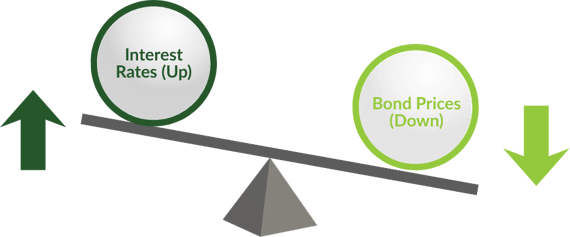
Bond prices and interest rates generally move in opposite directions. Simplified illustration for educational purposes only.
For example, imagine you own a bond that pays 3% interest. If newly issued bonds begin offering 5%, investors would generally be less willing to pay the same price for your bond when they could purchase a new one with a higher yield. To attract a buyer, the price of your existing bond would likely need to decrease.
What Makes Up a Bond’s Total Return?
A bond's market value is only one part of its overall performance. Its total return generally comes from two sources:
|
PRICE RETURN Changes in a bond's market value. When interest rates rise, bond prices generally decline, which can negatively affect returns. |
INCOME RETURN Interest earned from holding the bond. In the historical total-return calculations used later in this article, interest payments are assumed to be reinvested. |
Together, these two components determine the total return investors experience over time.
The immediate effects of rising rates are easy to see. Bond prices can decline, and performance reports may look disappointing.
The longer-term effect develops more gradually. As bonds mature and interest payments are reinvested, higher prevailing yields may allow the portfolio's income to increase.
While this doesn't guarantee better overall returns, it helps explain why focusing only on recent price declines can leave out an important part of the bond-investing story.
Putting Historical Bond Returns in Perspective
To place recent results in a broader context, we reviewed monthly total returns for the Bloomberg U.S. Aggregate Bond Index from January 31, 1976, through September 30, 2026. We then compared cumulative index returns across rolling 1-, 3-, 5-, and 10-year periods.
The results show how the frequency of positive returns varied across different holding periods:
|
Rolling holding period |
Periods with positive cumulative returns |
|
1 year |
87% |
|
3 years |
94% |
|
5 years |
95% |
|
10 years |
100% |
Source: Bloomberg U.S. Aggregate Bond Index monthly total returns, January 31, 1976–September 30, 2026, obtained through the Dimensional Fund Advisors Returns Program. Calculations by Prosperity Planning, Inc.
The longer historical periods provide useful perspective, but they aren't a prescription for how long someone should own bonds. In this data set, every rolling 10-year period had a positive cumulative return. That is an interesting historical result, not a promise about the next 10 years.
What Happened After Negative Bond-Market Years?
Negative calendar years were uncommon in this history. Of the 50 completed calendar years from 1976 through 2025, forty-five were positive and five were negative.
For three of those negative years, five subsequent completed calendar years are available:
|
Negative year |
Return that year |
Following 5 years, cumulative |
|
1994 |
-2.9% |
+45.1% |
|
1999 |
-0.8% |
+45.0% |
|
2013 |
-2.0% |
+13.3% |
Source: Bloomberg U.S. Aggregate Bond Index monthly total returns, January 31, 1976–September 30, 2026, obtained through the Dimensional Fund Advisors Returns Program. Calculations by Prosperity Planning, Inc.
The five-year figures are cumulative, not annualized, and begin after each negative calendar year. The negative years of 2021 and 2022 are not included because five subsequent completed calendar years are not yet available.
These examples don't tell us what will happen after the next negative bond-market year. They simply show that one negative calendar year didn't determine the longer-term experience in these three historical periods.
Why Bonds Still Matter in a Diversified Portfolio
Most investors do not own bonds because they expect bonds to outperform stocks over long periods.
Bonds typically serve a different purpose.
Depending on an investor’s circumstances, high-quality bonds can help:
- Generate portfolio income.
- Support planned withdrawals during retirement.
- Diversify stock-market risk.
- Moderate overall portfolio volatility.
- Provide capital for future spending needs.
For an investor approaching retirement or taking regular portfolio withdrawals, these functions can be just as important as the return of any individual investment.
Higher yields do not eliminate bond risk. Bonds remain subject to changes in interest rates, inflation, credit quality, liquidity, and reinvestment conditions. Yet today’s higher yields may allow bonds to generate more income than they did during the extremely low-rate environment that characterized much of the previous decade.
Should Investors Move From Bonds to Cash?
After a difficult period for bonds, cash can feel particularly appealing. Cash is generally less sensitive to changing interest rates, and current yields may appear competitive.
Cash and bonds serve different purposes, however.
Cash can be appropriate for emergency reserves, upcoming expenses, and other short-term needs. A diversified bond allocation is generally intended to support longer-term income, diversification, and portfolio objectives.
Moving a long-term bond allocation into cash may reduce short-term price movement, but it can also change the portfolio’s income potential, reinvestment risk, and diversification characteristics.
The decision should not be based solely on which investment currently offers the highest quoted yield. It should begin with the purpose of the money and the investor’s broader financial plan.
Is a Bond Allocation Still Appropriate?
A disappointing return does not automatically mean an investment strategy is broken.
The more useful questions are:
- What role was the bond allocation intended to serve?
- When might the money be needed?
- Has the investor’s financial plan changed?
- Is the portfolio still aligned with the investor’s goals, spending needs, and ability to take risk?
The appropriate allocation will vary from one investor to another. Credit quality, maturity, duration, taxes, liquidity needs, and expected holding period all matter. It also matters whether the investor owns individual bonds or a bond fund. An individual bond has a specified maturity date, while a bond fund typically maintains an ongoing portfolio of bonds and does not have a single maturity date when principal is returned.
The goal is not to predict the Federal Reserve’s next decision. It is to hold an investment strategy designed to support the investor’s financial plan through a variety of market environments.
The Bottom Line
It's understandable to have questions about bonds after a period of disappointing returns. But recent performance is only one part of the picture.
Financial headlines focus on recent performance because recent performance attracts attention.
Long-term investors benefit from focusing on something different.
Higher interest rates created real challenges for bond prices. They also increased the income available from many high-quality fixed-income investments.
History does remind us, however, that a difficult year has rarely told the entire story.
For disciplined investors, the most important question may not be, “What will bonds return next year?”
It may be: Are the bonds in my portfolio still serving the purpose they were selected to fulfill within my long-term financial plan?
At Prosperity Planning, our team of CFP® professionals helps clients evaluate their investments in the context of their overall financial plan, from retirement planning and tax considerations to their long-term goals.
If recent bond performance has left you questioning whether your investment strategy still fits your needs, we'd welcome the opportunity to talk. Schedule a conversation with our team to learn how comprehensive financial planning can help bring greater clarity to your investment decisions.
Ready to get Started?
Schedule a call with one of our Certified Financial Planner™ (CFP®) professionals today!

DATA NOTES AND DISCLOSURE
Prosperity Planning analyzed monthly total returns in U.S. dollars for the Bloomberg U.S. Aggregate Bond Index from January 31, 1976, through September 30, 2026, using data exported from the Dimensional Fund Advisors Returns Program on October 12, 2026.
Total return reflects price changes and reinvested income. Each rolling period begins one month after the prior period, so many periods share the same monthly returns and should not be viewed as entirely separate observations. Calendar-year analysis used the 50 completed years from 1976 through 2025. Five-year figures following negative years are cumulative, begin after the applicable negative calendar year, and include only negative years with five subsequent completed calendar years. Prosperity Planning selected the index, measurement periods, and examples. Index returns are unmanaged, cannot be invested in directly, and do not reflect advisory fees, transaction costs, taxes, or inflation. Past performance does not guarantee future results.
Prosperity Planning is neither an attorney nor an accountant, and no portion of the content should be interpreted as legal, accounting or tax advice. Be sure to consult with a tax professional before implementing any investment strategy. Investment advice, financial planning, and retirement plan services are provided by Prosperity Planning, Inc., an SEC registered investment advisor. The information contained herein, including but not limited to research, market valuations, calculations, estimates and other material obtained from these sources are believed to be reliable. However, Prosperity Planning, Inc. does not warrant its accuracy or completeness. The information contained herein has been prepared solely for informational purposes and is not an offer to buy or sell or a solicitation of an offer to buy or sell any security or to participate in any trading strategy. If an offer of securities is made, it will be under a definitive investment management agreement prepared on behalf of Prosperity which contains material information not contained herein and which supersedes this information in its entirety. Any investment involves significant risk, including a complete loss of capital and conflicts of interest. The applicable definitive investment management agreement and Form ADV Part 2A will contain a more thorough discussion of risk and conflict, which should be carefully reviewed before making any investment decision..


